
(Spin Digit Editorial):- Shenzhen, Guangdong Jun 25, 2026 (Issuewire.com) – Electronics manufacturing services face strict engineering challenges during the layout and assembly of embedded hardware modules. Modern electronic devices require continuous backup power to sustain real-time clocks and non-volatile memory chips during main power interruptions. Consequently, design engineers specify primary lithium coin cells equipped with permanent solder terminals to mount directly onto printed circuit boards. Evaluating manufacturing vendors requires locating a Certified Solder Tab Lithium Coin Cell Battery Exporter capable of maintaining flawless technical execution throughout the product lifecycle.
High-volume automated production lines demand exceptional physical tolerances and perfect electrical properties from every single component. A weak or poorly attached terminal lead can compromise an entire electronic module, causing premature field failures and expensive warranty claims. Therefore, strategic procurement managers utilize structured, technical checklists to audit potential exporters before integrating cells into high-density layouts. This comprehensive guide establishes a clear step-by-step roadmap for selecting premium tabbed power units for sensitive industrial electronics.
More on Spindigit:
- Kyle Nunes Medeiros Returns to YouTube, Announces The Kyle Nunes Medeiros Show
- Free Garage-Door Lube-Ups — and a “No-Pitch Promise” — as a Local Company Pushes Back on Home-Service Sales Tactics
- Jack Longman’s One Last Snide Comment Explores Grief, Addiction, Love, and the Struggle to Keep Going
- Why Investors Are Pouring Capital Into Robotic Coffee Startups in 2026 — and Where the Smart Money Is Going
- How to Choose the Best Black Golf Cart for Your Needs?
Step 1: Auditing Thermal Shock Mitigation in Automated Micro-Spot Welding Lines
Solder tab fabrication represents the most critical mechanical phase in the production of board-mounted primary cells. Solder terminals must bond securely to the positive stainless steel shell and the negative cap of a lithium manganese dioxide cell. However, traditional manual soldering or uncalibrated welding equipment transfers excessive thermal energy into the internal components. This severe thermal shock melts the thin polypropylene internal separator and degrades the synthetic rubber insulating gasket.
As a direct result, the cell experiences high internal self-discharge or slow electrolyte leakage over several months of field operation. Escaping organic electrolyte chemicals corrode neighboring copper traces on the printed circuit board, destroying the host device entirely. Premium industrial exporters like PKCell eliminate this significant vulnerability by investing in specialized micro-spot welding systems. These computerized machines utilize automated dual-pulse profiles to complete tab attachment within milliseconds.
In addition, integrated pneumatic cooling clamps instantly absorb residual heat from the metal casing. This precise engineering approach preserves internal chemical structures and prevents early capacity degradation. Sourcing officers must verify that their chosen factory tracks welding energy and mechanical pressure parameters for every manufacturing batch.
Step 2: Evaluating Lead Geometry Compatibility for High-Yield SMT and DIP Assembly
Automated assembly lines operate at high speeds and require perfect component uniformity to maintain profitable yield rates. Solder tab configurations must match the strict dimensional specifications of automated pick-and-place equipment and automated optical inspection systems. Sourcing teams must carefully evaluate terminal pin coplanarity, geometric alignment, and overall dimensional tolerances. Minor dimensional variations can cause component jams inside feeder systems or lead to misaligned placement on circuit boards.
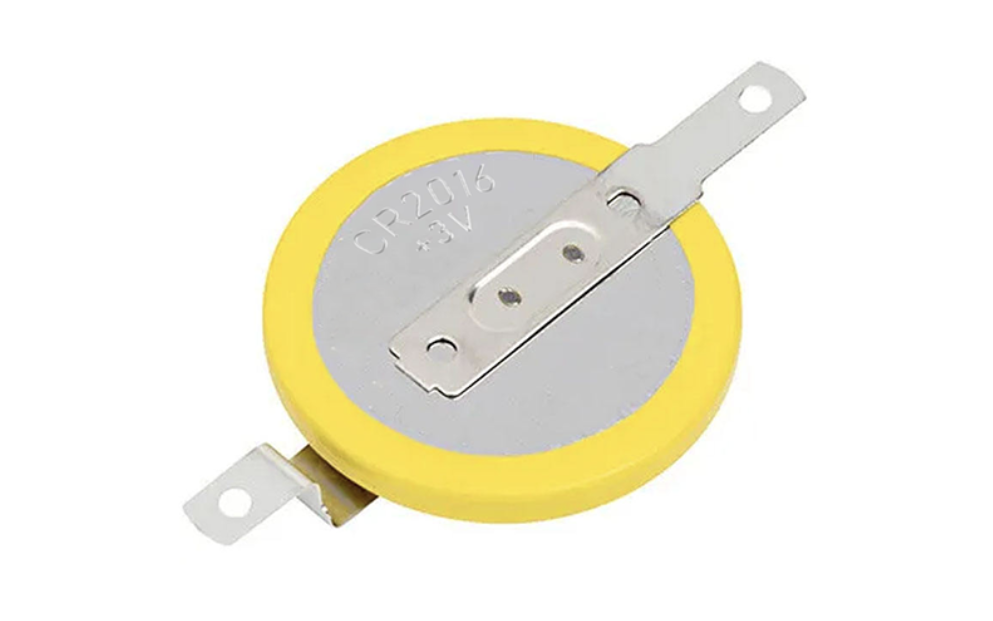
Solderability represents another vital metric because oxidized terminals cause cold joints and weak electrical connections during wave soldering processes. Industrial cells like the 3V CR2016 lithium button cell battery with leadtab demonstrate the tight tolerances required for high-yield manufacturing. This specialized cell features pristine nickel plating over a robust stainless steel base metal to ensure swift solder wetting.
Furthermore, Shenzhen Pkcell Battery Co., Ltd. provides an extensive matrix of standard terminal styles, including multi-pin surface mount designs and through-hole configurations. Engineers can specify custom tab geometries, pre-applied insulating sleeves, and specific pin spacings to accommodate dense board topologies. Sourcing professionals must confirm that the supplier tests terminal pull strength to withstand mechanical vibrations.
Step 3: Verifying Electrochemical Baselines–Low Internal Resistance and Anti-Leakage Chemistry
Solder tab batteries must deliver reliable electrical performance long after initial board assembly. Backup power components often remain in an idle state for years, yet they must instantly supply current during main power outages. Therefore, verifying the electrochemical baseline of the raw cell represents a critical stage in the procurement evaluation process. Low and stable internal resistance is essential because micro-controllers require clean, stable voltage during sudden sleep-to-wake transmission pulses.
Substandard primary batteries frequently suffer from high internal resistance, causing sharp voltage drops that trigger false low-power errors in device firmware. High-tier manufacturers enforce strict humidity controls inside specialized dry rooms during cell fabrication. This rigorous manufacturing environment ensures a very low annual self-discharge rate of less than one percent for lithium manganese dioxide cells.
In addition, the internal structural design utilizes a multi-layer anti-leakage barrier system to contain the organic electrolyte securely under thermal stress. PKCell optimizes its internal cell formulations to maintain consistent voltage outputs across diverse temperature conditions. This superior electrical performance guarantees that real-time clocks continue tracking accurately in harsh industrial zones or unconditioned outdoor enclosures.
Step 4: Confirming Global Dangerous Goods Compliance and Supply Chain Logistics Security
Primary lithium button cells fall under the strict classification of Class 9 dangerous goods within international transport frameworks. Modifying cells with custom welded terminals requires careful adherence to global shipping protocols. Sourcing departments must ensure that their chosen industrial exporter provides a comprehensive, fully certified documentation package to prevent customs delays. To eliminate administrative hurdles at international borders, PKCell (Shenzhen Pkcell Battery Co., Ltd.) maintains a complete portfolio of global regulatory approvals.
The production facilities operate under certified ISO9001 systems to guarantee complete process traceability. Furthermore, the exporter delivers fully updated Material Safety Data Sheets and certified UN38.3 transport testing documentation for every tabbed configuration. These official records confirm that the custom assemblies withstand severe vibration, impact, and thermal cycling tests without structural failure. Compliance with RoHS directives and REACH regulations also ensures unrestricted access to strictly regulated European and North American consumer markets. Sourcing specialists must demand these verified certificates during early quotation stages to protect their corporate supply lines from customs seizures.
Conclusion
Moving from basic component purchasing to an engineering-driven sourcing model is essential for long-term project success. Implementing a rigorous step-by-step checklist during factory evaluation helps electronic manufacturing firms minimize operational liabilities and eliminate costly field failures. Verifying thermal welding precision, dimensional uniformity, electrochemical stability, and international transport compliance protects advanced hardware designs. By forming strategic alliances with certified industrial battery exporters, original equipment manufacturers guarantee production continuity and deliver exceptional product reliability worldwide.
Learn more about custom board-mount power configurations at: https://www.pkcellpower.com/.
Media Contact
Shenzhen Pkcell Battery Co., Ltd.
902, Tower B, Hongrongyuan North Station Center, North Station Community, Minzhi Street, Longhua District, Shenzhen, China
Source :Shenzhen Pkcell Battery Co., Ltd.
This article was originally published by IssueWire. Read the original article here.