

(Spin Digit Editorial):- Longkou, Shandong Jun 14, 2026 (Issuewire.com) – “The clarity and lightweight feel of these lead glasses are remarkable; our interventional radiology team felt an immediate difference in comfort during extended procedures,” noted a senior procurement director from a leading Middle East hospital network at the recently concluded WHX Dubai 2026.
This professional acclaim underscores a growing industry realization: selecting a Professional Lead Glasses Manufacturer requires evaluating far more than a simple lead equivalency rating. As medical imaging, digital subtraction angiography, and image-guided interventions expand globally, understanding the precise engineering behind ocular radiation protection becomes critical for clinical administrators, radiation safety officers, and healthcare buyers. This comprehensive buyer’s guide explores the vital parameters of high-grade protective eyewear, drawing on the advanced design paradigms showcased by industry pioneers to help procurement professionals make informed, safety-critical decisions.
More on Spindigit:
- Dmitry Druzhinsky Connects Tennis Training Continuity at MatchPoint NYC With Lessons From the US Open and Wuhan Open
- DGA Equipment LLC Showcases Equipment Options for Agriculture and Construction
- Unlocking Potential with Redfy: A Smart 660nm 850nm Red Light Therapy Manufacturer Driving the Wellness Industry
- Akilbek Allan: Building a Distinct musical Identity Through Creativity and New Projects
- Clear and Present Public Health Emergency
The World Health Expo (WHX) Dubai 2026, formerly known as Arab Health, has solidified its reputation as a leading international benchmark for the medical and healthcare sector across the Middle East, North Africa, and global markets. Moving to the expansive Dubai Exhibition Centre at Expo City Dubai to accommodate unprecedented scale, WHX Dubai 2026 brought together over 4,300 exhibitors and more than 235,000 visitors from 180 countries. Serving as a massive convergence point for medical device innovation, diagnostics, and clinical safety, the expo acts as a top-tier authoritative platform where strict international standards are validated and cutting-edge clinical solutions are commercialized. For radiation protection manufacturers, this event is the ultimate proving ground, where regulatory compliance, ergonomic durability, and material innovation are scrutinized by global policy makers, clinical experts, and specialized distributors who demand high reliability.
To navigate the complex market of personal protective equipment and ensure maximum occupational health for medical staff, procurement departments must adopt a systematic, multi-step framework when selecting a manufacturing partner.
STEP 1: Verifying Regulatory Certifications and Manufacturing Heritage
The primary indicator of a legitimate manufacturer is its compliance with international quality management structures and specific medical device standards. Buyers should verify that the manufacturer holds active ISO 9001 and ISO 13485 certifications, which govern the design, manufacturing, and continuous quality oversight of medical devices. Furthermore, a deep historical foundation in radiation physics and material science often correlates with stable product engineering and long-term product reliability in demanding clinical settings.
For instance, DOUBLE EAGLE, legally registered as Shandong Double Eagle Medical Device Co., Ltd., holds a foundational position in this sector. Having developed the first Chinese lead apron in 1978 and the milestone QH80 protective apron in 1980, the enterprise established foundational enterprise standards for X-ray protection. Over the decades, the company expanded from soft, ultra-thin protective lead rubber sheets in 1996 to specialized security machine lead curtains, building a massive 20,000 square meter modernized factory in the High-tech Industrial Park. This extensive historical lineage ensures that the manufacturing processes utilized for specialized items like lead glasses are backed by decades of documented quality control, standard testing methodologies, and continuous research and development.
STEP 2: Assessing Lead Equivalency and Radiation Attenuation Consistency
A critical evaluation of lead glasses must focus on the high uniformity of the radiation attenuation layer. In high-exposure environments, such as interventional cardiology, fluoroscopy, electrophysiology, and computed tomography rooms, scatter radiation poses a continuous threat of radiation-induced cataracts to medical staff who spend hundreds of hours near X-ray tubes. Buyers must ensure that the lead glass features a standardized lead equivalency–typically 0.75mmPb–which effectively attenuates over 99% of scatter X-ray radiation.
The technical architecture of premium protective eyewear relies on high-density lead glass formulations. For example, technical specifications for advanced models highlight an optimal balance between maximum shielding and structural weight. The core component consists of optical-grade lead glass plates that undergo meticulous grinding and polishing to eliminate internal micro-bubbles, striations, or inclusions that could impair visual acuity or cause localized radiation leakage. The attenuation must be uniform across the entire surface area of the lens, ensuring that peripheral field views are granted identical protection levels compared to the direct line of sight. Lower-tier manufacturers often suffer from composition variance, leading to unsafe pockets where radiation can penetrate.
STEP 3: Evaluating Ergonomic Fit, Weight Distribution, and Side Shielding
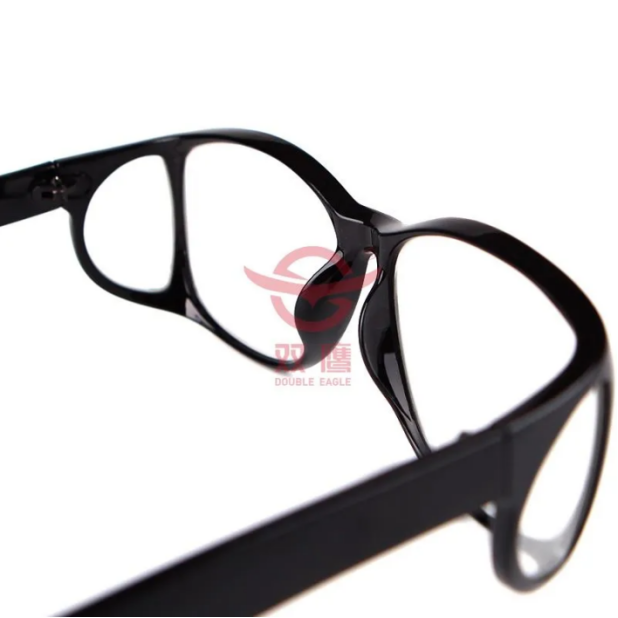
A common point of failure for standard protective eyewear is a heavy, poorly balanced frame, which leads to physical fatigue, slipping, and compliance issues among medical staff during long surgical procedures. Professional manufacturers design frames that distribute the weight of the high-density lead lenses evenly across the nasal bridge and the temporal bones. The inclusion of soft, adjustable non-slip nose pads and flexible temple arms significantly enhances wearer comfort and compliance over multiple hours.
Furthermore, direct forward protection is insufficient in modern clinical theaters where scatter radiation approaches from multiple angles, reflecting off the patient’s body and surrounding surgical tables. High-performance models incorporate lateral radiation protection. This is accomplished either through contoured wrap-around frame architectures or by embedding dedicated side shields with a minimum lead equivalency of 0.50mmPb. These side elements must fit flush against the primary frame, eliminating any unshielded gaps while preserving the user’s peripheral vision. Frame materials must also be highly durable, utilizing impact-resistant medical-grade polymers or lightweight alloys that withstand frequent cleaning, UV sterilization, and harsh chemical disinfection protocols.
STEP 4: Examining Optical Clarity and Specialized Performance Customization
The final step in the buyer’s guide involves analyzing the optical performance of the protective lenses. High-quality lead glass must maintain an exceptional light transmission rate to prevent eye strain and ensure precise visualization of high-resolution diagnostic monitors. Standard industrial lead glass often exhibits a heavy yellow tint or high reflectivity; professional medical-grade manufacturers utilize advanced anti-reflective coatings and high-purity raw materials to maximize light transmission while minimizing chromatic aberrations.
Modern clinical environments demand versatile, customizable solutions to accommodate different physical environments and staff requirements. These specialized applications span across multiple environments:
- Interventional Radiology and Cardiology:Where long hours under real-time fluoroscopy necessitate wrap-around styles with maximum side shielding to block scatter from lateral angles.
- Operating Rooms and Orthopedic Surgery:Where portable C-arm utilization requires lightweight, impact-resistant frames that fit securely during physical maneuvers.
- CT and Radionuclide Labs:Demanding robust specialized configurations to protect operators during patient positioning, therapeutic delivery, and scanning cycles.
- Security Inspection Systems:Utilizing heavy-duty shielding components derived from the same core radiation shielding technologies used in medical clinics.
To address individual operator requirements, professional manufacturers offer customized optical prescriptions, integrating single-vision or progressive corrective optics directly into the leaded glass matrix without compromising the 0.75mmPb protective integrity, ensuring each practitioner maintains perfect visual acuity during delicate interventions.
As the medical industry demands higher standards of occupational safety, healthcare facilities must move away from generic suppliers and build partnerships with verified manufacturing specialists. By systematically evaluating manufacturing heritage, certification validity, precise material parameters, and ergonomic innovations, procurement teams can successfully safeguard their clinical workforce. Industry showcases like WHX Dubai 2026 continue to demonstrate that technical transparency, rigorous engineering, and uncompromising commitment to safety remain the ultimate benchmarks for superior radiation protection.
For more technical specifications, product catalogs, and application inquiries, please visit the official corporate portal at https://www.doubleeaglexray.com
Source :Shandong Double Eagle Medical Device Co., Ltd.
This article was originally published by IssueWire. Read the original article here.