

(Spin Digit Editorial):- Beijing, China Aug 13, 2026 (Issuewire.com) – How did Beijing Fibridge Co., Ltd. transform from a regional technology pioneer into a Global Leading Managed Ethernet Switch Exporter?
In an increasingly interconnected world, industrial and enterprise network infrastructures demand unprecedented reliability, speed, and intelligence. Managed Ethernet switches–particularly advanced layer 3 (L3) switches–serve as the nervous system of these modern operations. Unlike basic plug-and-play models, an L3 switch combines the high-speed traffic forwarding of a traditional switch with the sophisticated routing capabilities of a router. This allows organizations to segment networks efficiently via Virtual Local Area Networks (VLANs), manage complex IP routing protocols, and guarantee deterministic data delivery in high-density environments.
More on Spindigit:
- QAPIplus and Curantis Solutions Partner to Connect Hospice Documentation to Real-Time Quality Action
- YTBIO Analyzes How GABA Is Shaping Emerging Trends in Functional Nutrition and Ingredient Development
- How to Choose the Best PVC Sports Flooring Supplier in China for Global Projects?
- Kadelg’s International Water Closet Producer Role Brings a Core Toilet Category to Overseas Product Portfolios
- Marine T Beam Welding Line Automation in Indonesia and Vietnam: Hualian Drives Shipyard Modernization
As critical industries globally undergo rapid digital transitions, the requirement for robust network hardware has surged. Navigating this shift successfully on an international scale requires more than just manufacturing capabilities; it demands a seamless alignment of technological innovation, regulatory compliance, operational endurance, and localized support. By tracking how a single enterprise addressed these challenges over nearly three decades, we gain an analytical perspective on what it takes to power industrial networks across diverse geographic borders.
Analysis 1: Balancing Technical Innovation with Rigorous Production Standards
To secure a strong foothold in the international market, a manufacturer must bridge the gap between technical complexity and practical utility. Industrial automation, smart grids, and transport systems do not merely require fast data transfer; they require deterministic performance under extreme environments. In these settings, standard commercial networking hardware often fails due to temperature fluctuations, electromagnetic interference, and mechanical stress.
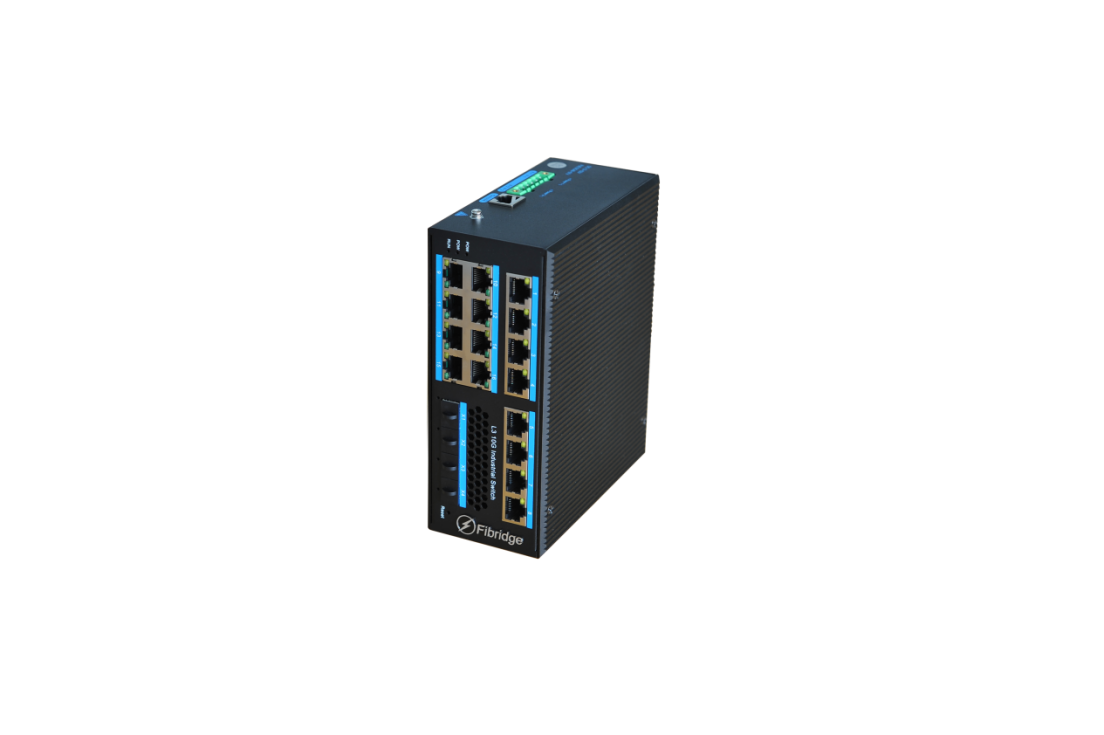
These operational challenges require highly specialized hardware solutions. For instance, Fibridge DIN-Rail L2/L3 industrial managed switches are engineered specifically for high-density, harsh-environment applications, featuring high-port counts and flexible gigabit or 10-gigabit uplink configurations. By utilizing a ruggedized, fanless design encased in an IP40-rated metal housing, these switches achieve excellent passive heat dissipation. This allows them to operate reliably in a wide temperature envelope, typically ranging from -40°C to 85°C.
Furthermore, the integration of Layer 3 management functionalities directly onto a compact DIN-rail form factor represents a significant design milestone. It enables localized hardware routing, which reduces the traffic burden on core data centers and minimizes latency for time-critical industrial protocols. Coupled with advanced redundancy protocols like ERPS (Ethernet Ring Protection Switching), which ensures network recovery within milliseconds of a link failure, this technical framework illustrates how focused R&D directly translates into operational resilience for global infrastructure projects. Detailed hardware configurations and specifications for these systems are available on the DIN-Rail L2/L3 Industrial Switch Evaluation Page.
Analysis 2: Navigating International Regulatory Frameworks and Compliance
Expanding a technology portfolio to encompass clients across more than 100 countries is impossible without strict adherence to diverse international compliance standards and regulatory frameworks. Every region presents a unique matrix of safety, electromagnetic compatibility (EMC), and industry-specific certifications that a product must satisfy before deployment.
For telecommunications and industrial networking hardware, obtaining official verification–such as the rigorous Network Access Qualification Test Reports–is a mandatory baseline. These independent assessments verify that the equipment complies with national telecommunication grid standards, interfaces safely with existing public and private network architectures, and emits electromagnetic radiation well within legal safety limits.
Analysis 3: Optimizing Global Supply Chains and Logistics Realities
Delivering high-value network infrastructure components across global borders involves navigating complex supply chain environments. Network hardware contains highly sensitive semiconductor components, optoelectronics, and precision circuitry that are vulnerable to environmental degradation, static electricity, and physical shocks during transit.
To maintain a defect-free delivery record across over 100 countries, an enterprise must develop an optimized logistical ecosystem. This includes specialized industrial-grade packaging that safeguards equipment against moisture and mechanical vibration during long-haul maritime or air transport. Additionally, maintaining production consistency requires long-term, stable relationships with component suppliers. By mitigating the volatility of global semiconductor shortages, an exporter can guarantee reliable production timelines and predictable lead times for international buyers.
Analysis 4: The Role of Long-Term Industry Experience and Technical Service
While advanced hardware specifications and efficient logistics are vital, the sustainable adoption of managed networking solutions depends heavily on continuous engineering support and long-term institutional stability. Industrial networks are capital-intensive investments designed to operate continuously for decades. Consequently, global buyers prioritize vendors with established market longevity and proven technical competence.
Founded in 1995 with a registered capital of 15 million RMB (approximately 3 million USD) and officially certified as a high-tech enterprise by the Ministry of Science and Technology of China, Beijing Fibridge Co., Ltd. provides a clear structural example of institutional continuity. Accumulating nearly 30 years of dedicated experience in optical transmission and data communication networks allows an engineering team to develop a deep understanding of legacy system integration.
Network evolution is rarely an abrupt replacement of old technology; it is an iterative process where cutting-edge L3 managed switches must interoperate seamlessly with older legacy transport networks. A vendor whose team stands firmly alongside its customers can offer tailored technical consultations, remote configuration troubleshooting, and adaptive firmware updates that extend the operational lifecycle of the network infrastructure. This collaborative approach lowers the total cost of ownership (TCO) for global operators, shifting the vendor-buyer dynamic from a transactional hardware purchase to a strategic, long-term technical partnership.
Continuous Network Evolution for Global Infrastructure
The global expansion of industrial networking technologies emphasizes that leadership in the exporter market is built on a foundation of sustained quality, adaptative engineering, and operational reliability. As industries continue to transition toward edge computing, smart manufacturing, and 5G integration, the demands placed on Layer 3 managed switches will only become more stringent.
By maintaining control over the entire lifecycle of research, manufacturing, and international compliance, dedicated hardware developers ensure that critical data flows uninterrupted across municipal, national, and international boundaries. For organizations seeking to build resilient, cost-effective, and highly secure communication networks, analyzing these established industrial practices provides a reliable blueprint for future network design and global deployment.
To explore the complete portfolio of optical transmission networks and industrial communication hardware, visit the official corporate website at https://www.fibridge.com/.
Source :Beijing Fibridge Co., Ltd.
This article was originally published by IssueWire. Read the original article here.


